



Google Calendar
This section provides the performance summary of the Google Calendar service managed through CCKM on the CipherTrust Manager server.
Requests Per Second
The following sections list the wrap requests per second, approximate latency, and the number of virtual users for different deployment scenarios.
To provide a good user experience, Google recommends a maximum latency of 200 ms (for 99% of the requests). Therefore, the performance numbers on this page are based on a latency of around 200 ms.
Google Cloud
| Server Location | Client Location |
|---|---|
| us-central1-a | us-central1-a |
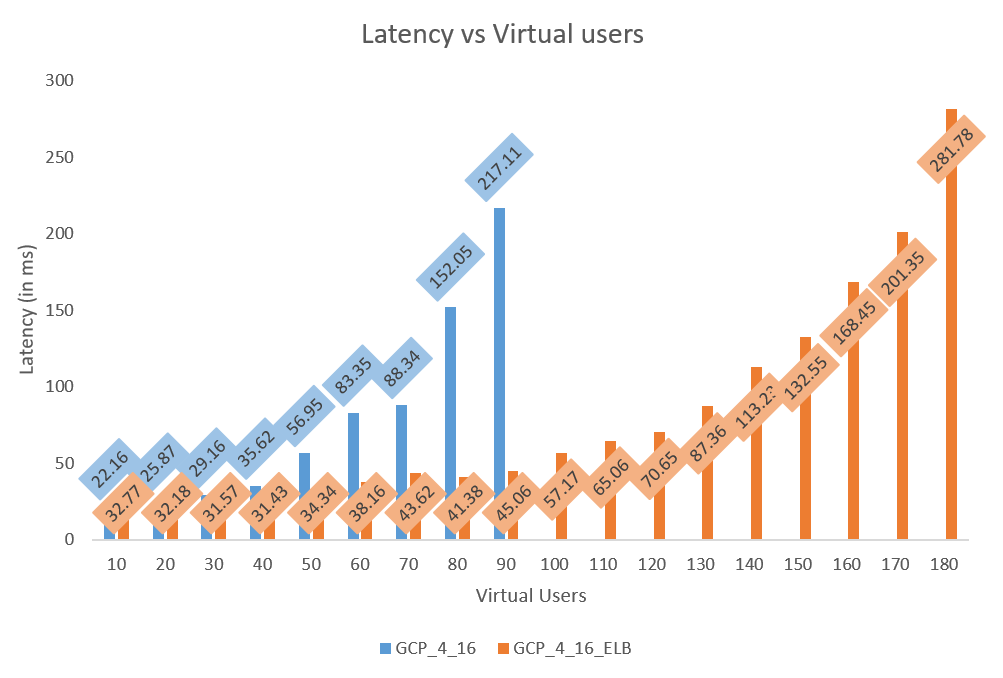
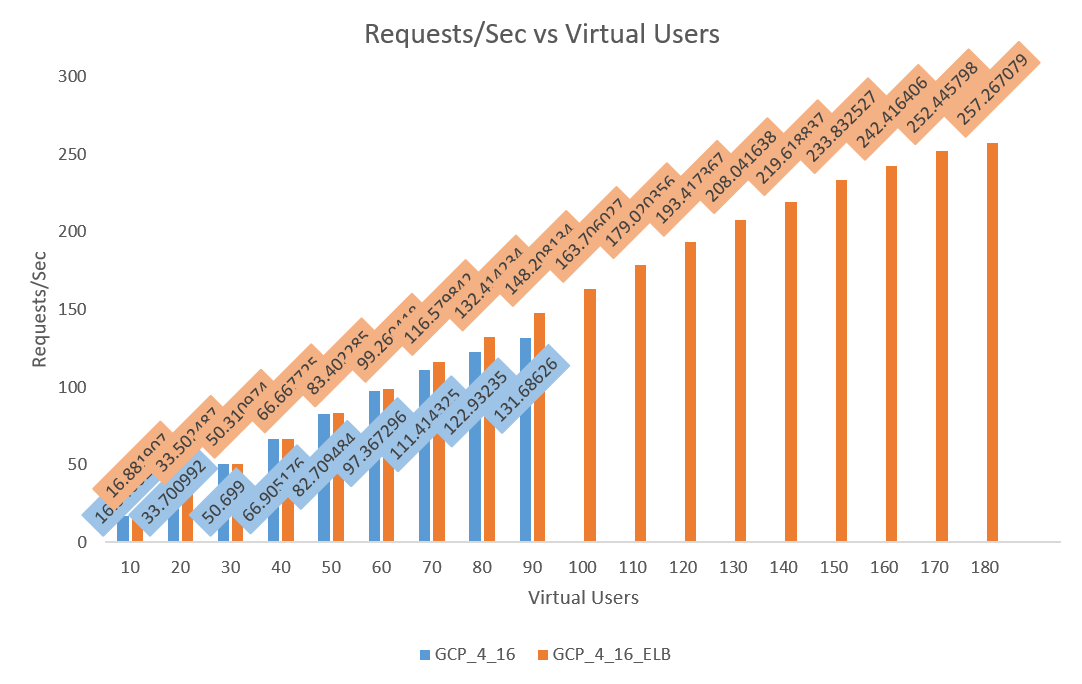
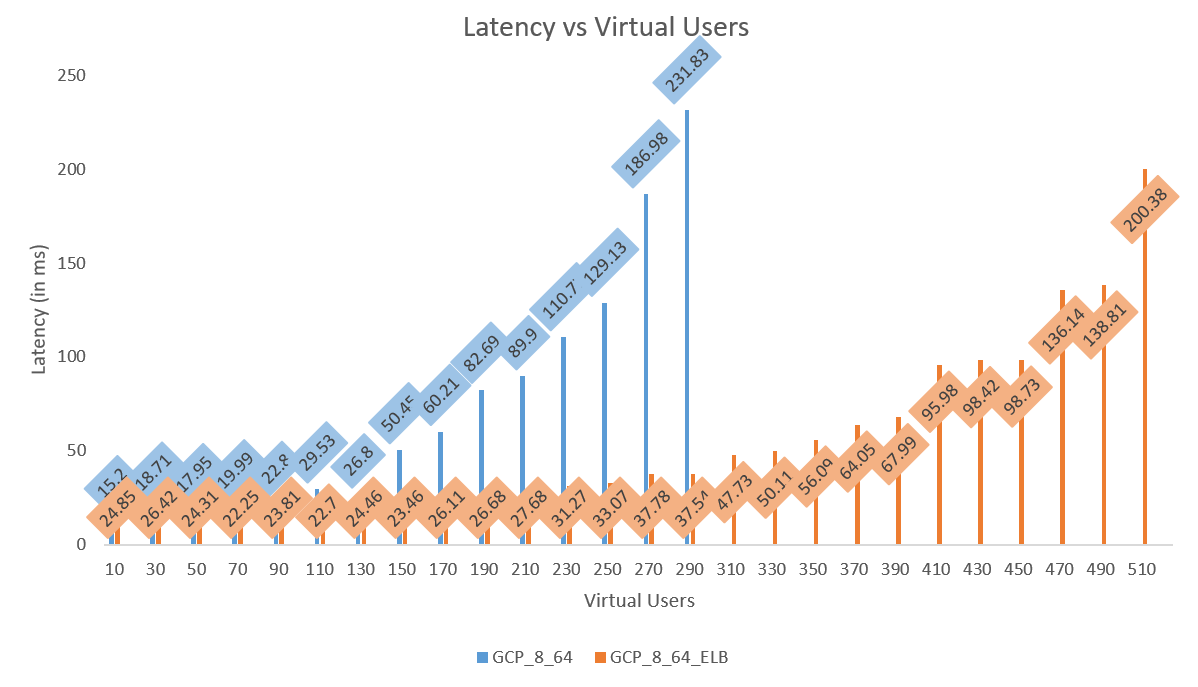
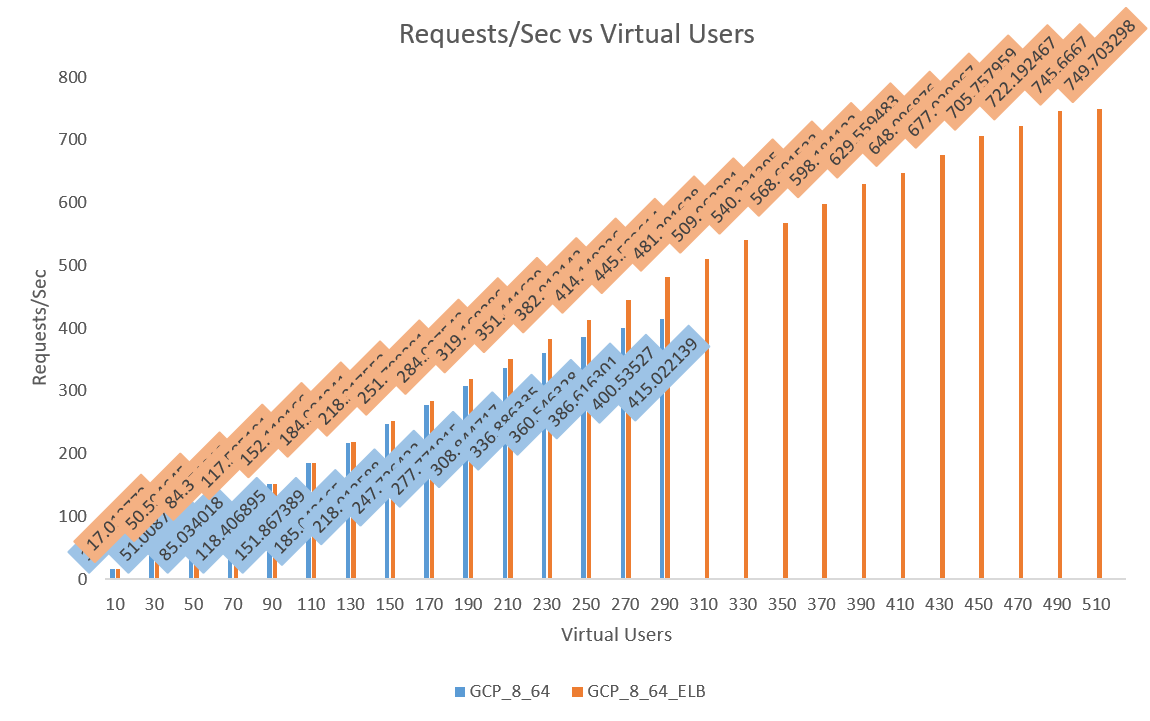
Simulated the wrap requests for Google Calendar on the CipherTrust Manager deployed on Google Cloud Platform using the k6 tool. The following table shows the handled number of requests per second (RPS), with approximate latency, and the number of virtual users for different data samples on a standalone CipherTrust Manager and a two-node CipherTrust Manager cluster connected with a load balancer.
Click a tab to view performance numbers based on two different specifications.
| System Volume | Memory | CPUs | NICs |
|---|---|---|---|
| 50 GB | 16 GB | 4 | 1 |
Click a tab to view performance numbers for a standalone CipherTrust Manager or a two-node cluster with a load balancer.
| Users | Latency (in ms) | Requests/Second |
|---|---|---|
| 10 | 22.16 | 16.94002 |
| 20 | 25.87 | 33.700992 |
| 30 | 29.16 | 50.699 |
| 40 | 35.62 | 66.905176 |
| 50 | 56.95 | 82.709484 |
| 60 | 83.35 | 97.367296 |
| 70 | 88.34 | 111.414325 |
| 80 | 152.05 | 122.93235 |
| 90 | 217.11 | 131.68626 |
| Users | Latency (in ms) | Requests/Second |
|---|---|---|
| 10 | 32.77 | 16.881907 |
| 20 | 32.18 | 33.502487 |
| 30 | 31.57 | 50.310974 |
| 40 | 31.43 | 66.667725 |
| 50 | 34.34 | 83.402285 |
| 60 | 38.16 | 99.260418 |
| 70 | 43.62 | 116.579842 |
| 80 | 41.38 | 132.414234 |
| 90 | 45.06 | 148.208134 |
| 100 | 57.17 | 163.706027 |
| 110 | 65.06 | 179.020356 |
| 120 | 70.65 | 193.417367 |
| 130 | 87.36 | 208.041638 |
| 140 | 113.23 | 219.618837 |
| 150 | 132.55 | 233.832527 |
| 160 | 168.45 | 242.416406 |
| 170 | 201.35 | 252.445798 |
Comparison Graphs
Specification 1: Standalone vs Two-Node Cluster with Load Balancer
| System Volume | Memory | CPUs | NICs |
|---|---|---|---|
| 50 GB | 64 GB | 8 | 1 |
Click a tab to view performance numbers for a standalone CipherTrust Manager or a two-node cluster with a load balancer.
| Users | Latency (in ms) | Requests/Second |
|---|---|---|
| 10 | 15.2 | 17.169325 |
| 30 | 18.71 | 51.008778 |
| 50 | 17.95 | 85.034018 |
| 70 | 19.99 | 118.406895 |
| 90 | 22.8 | 151.867389 |
| 110 | 29.53 | 185.042165 |
| 130 | 26.8 | 218.012588 |
| 150 | 50.45 | 247.726422 |
| 170 | 60.21 | 277.771915 |
| 190 | 82.69 | 308.844717 |
| 210 | 89.9 | 336.886335 |
| 230 | 110.77 | 360.546328 |
| 250 | 129.13 | 386.616301 |
| 270 | 186.98 | 400.53527 |
| 290 | 231.83 | 415.022139 |
| Users | Latency (in ms) | Requests/Second |
|---|---|---|
| 10 | 24.85 | 17.013772 |
| 30 | 26.42 | 50.594645 |
| 50 | 24.31 | 84.351819 |
| 70 | 22.25 | 117.585101 |
| 90 | 23.81 | 152.119166 |
| 110 | 22.7 | 184.904241 |
| 130 | 24.46 | 218.317553 |
| 150 | 23.46 | 251.799291 |
| 170 | 26.11 | 284.927543 |
| 190 | 26.68 | 319.168286 |
| 210 | 27.68 | 351.441629 |
| 230 | 31.27 | 382.913143 |
| 250 | 33.07 | 414.149236 |
| 270 | 37.78 | 445.583614 |
| 290 | 37.54 | 481.201628 |
| 310 | 47.73 | 509.962281 |
| 330 | 50.11 | 540.231395 |
| 350 | 56.09 | 568.691533 |
| 370 | 64.05 | 598.184122 |
| 390 | 67.99 | 629.559483 |
| 410 | 95.98 | 648.096876 |
| 430 | 98.42 | 677.029967 |
| 450 | 98.73 | 705.757959 |
| 470 | 136.14 | 722.192467 |
| 490 | 138.81 | 745.6667 |
| 510 | 200.38 | 749.703298 |
Comparison Graphs
Specification 2: Standalone vs Two-Node Cluster with Load Balancer
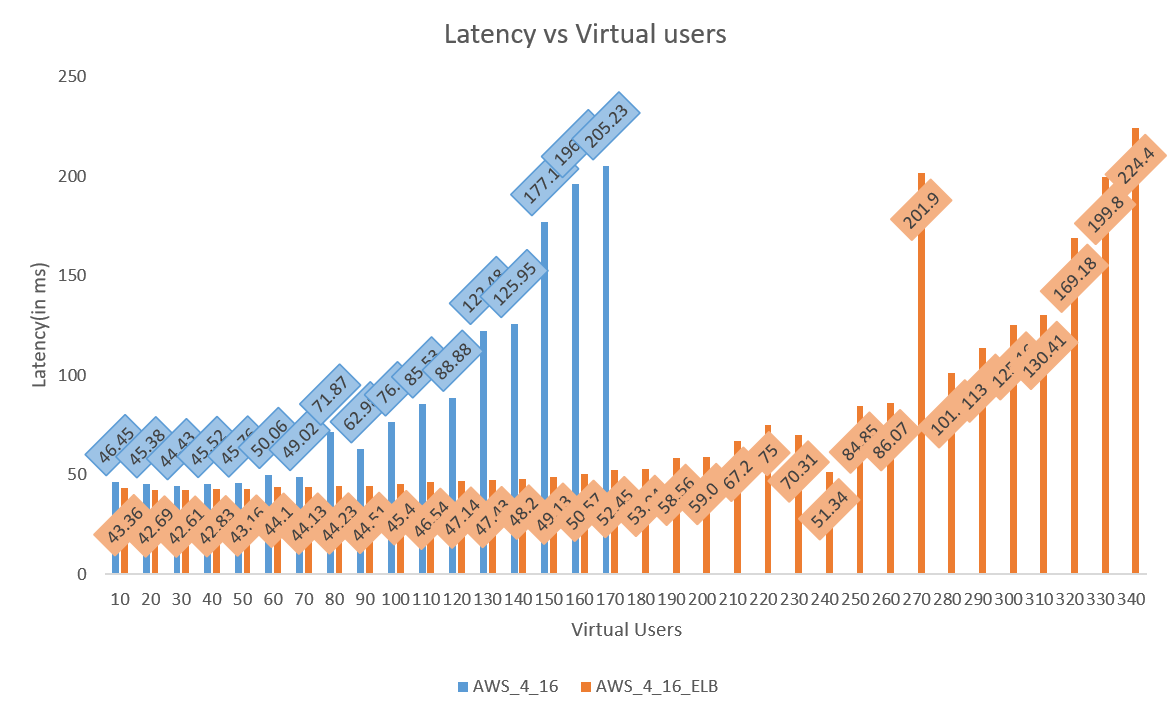
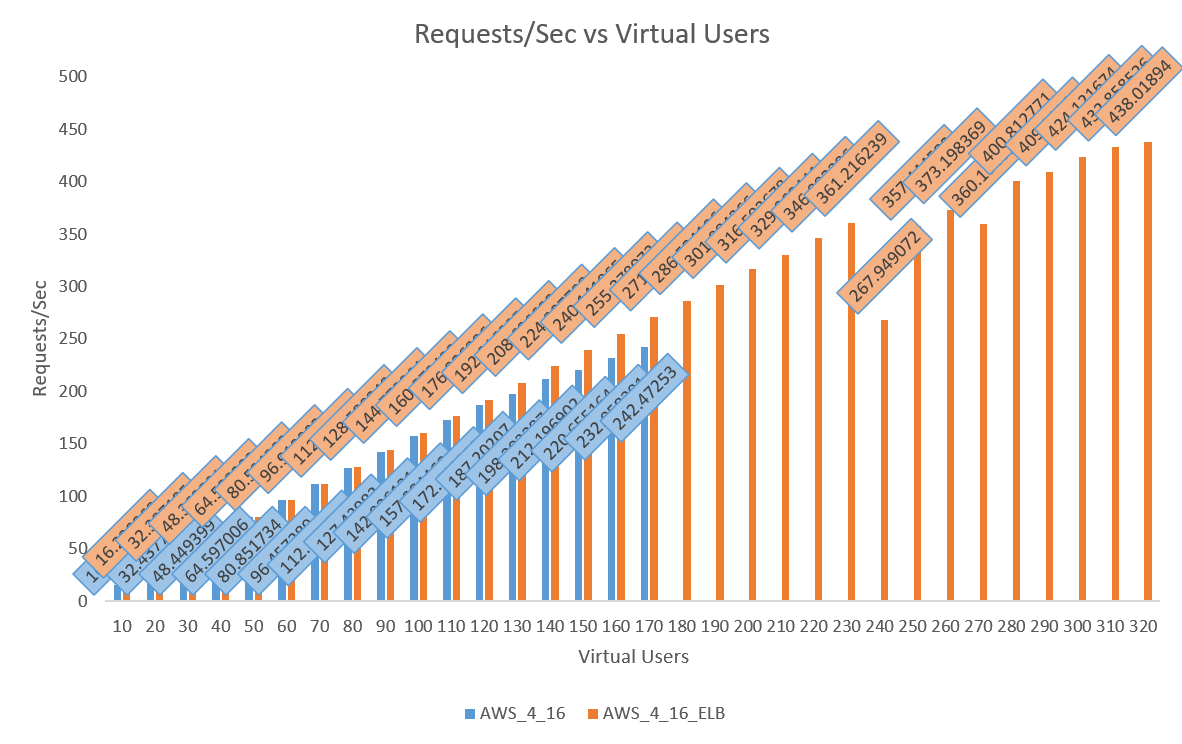
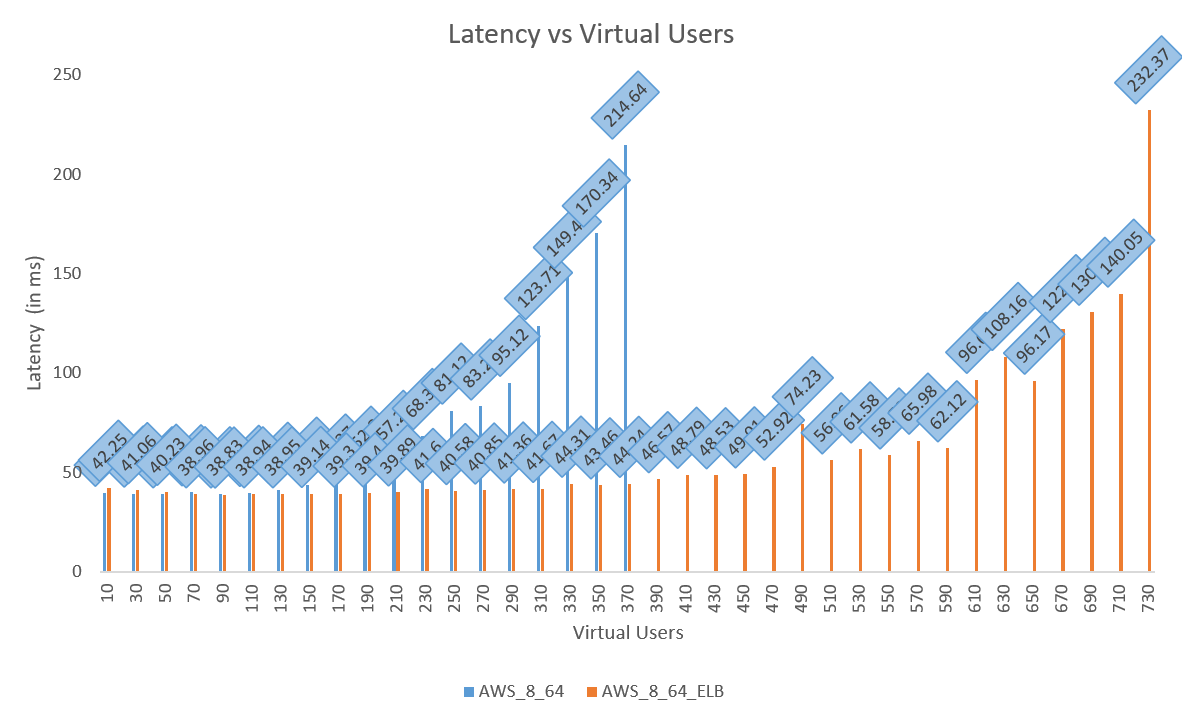
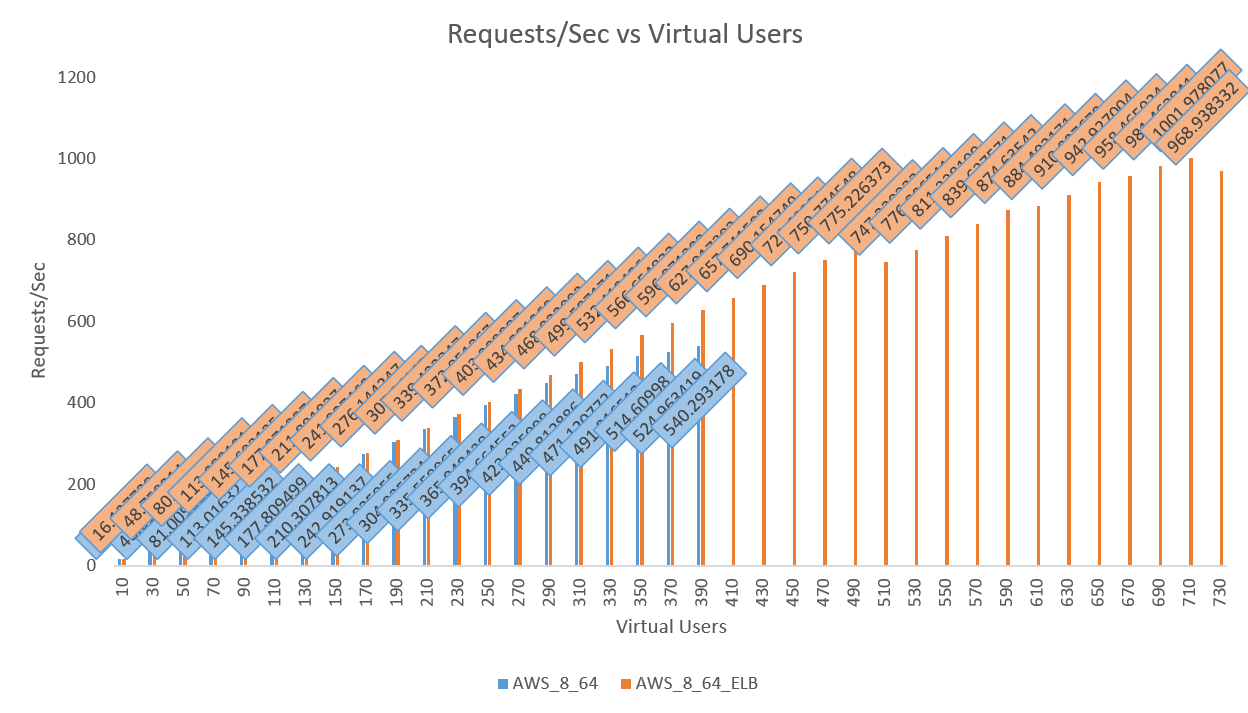
AWS Cloud
| Server Location | Client Location |
|---|---|
| us-east-1b | us-central1-a |
Simulated the wrap requests for Google Calendar on the CipherTrust Manager deployed on AWS cloud using the k6 tool. The following table shows the handled number of requests per second (RPS), with approximate latency, and the number of virtual users for different data samples on a standalone CipherTrust Manager and a two-node CipherTrust Manager cluster connected with a load balancer.
Click a tab to view performance numbers based on two different specifications.
| System Volume | Memory | CPUs | NICs |
|---|---|---|---|
| 50 GB | 16 GB | 4 | 1 |
Click a tab to view performance numbers for a standalone CipherTrust Manager or a two-node cluster with a load balancer.
| Users | Latency (in ms) | Requests/Second |
|---|---|---|
| 10 | 46.45 | 16.187459 |
| 20 | 45.38 | 32.437778 |
| 30 | 44.43 | 48.449399 |
| 40 | 45.52 | 64.597006 |
| 50 | 45.76 | 80.851734 |
| 60 | 50.06 | 96.457289 |
| 70 | 49.02 | 112.148661 |
| 80 | 71.87 | 127.43983 |
| 90 | 62.98 | 142.926131 |
| 100 | 76.5 | 157.384469 |
| 110 | 85.53 | 172.640989 |
| 120 | 88.88 | 187.20207 |
| 130 | 122.48 | 198.203387 |
| 140 | 125.95 | 212.196902 |
| 150 | 177.16 | 220.655164 |
| 160 | 196.31 | 232.058391 |
| 170 | 205.23 | 242.47253 |
| Users | Latency (in ms) | Requests/Second |
|---|---|---|
| 10 | 43.36 | 16.230968 |
| 20 | 42.69 | 32.307195 |
| 30 | 42.61 | 48.362801 |
| 40 | 42.83 | 64.588292 |
| 50 | 43.16 | 80.524303 |
| 60 | 44.1 | 96.912002 |
| 70 | 44.13 | 112.44579 |
| 80 | 44.23 | 128.580249 |
| 90 | 44.51 | 144.772264 |
| 100 | 45.4 | 160.873428 |
| 110 | 46.54 | 176.926386 |
| 120 | 47.14 | 192.216205 |
| 130 | 47.43 | 208.636698 |
| 140 | 48.2 | 224.307708 |
| 150 | 49.13 | 240.141065 |
| 160 | 50.57 | 255.278072 |
| 170 | 52.45 | 271.01118 |
| 180 | 53.04 | 286.524106 |
| 190 | 58.56 | 301.984366 |
| 200 | 59.01 | 316.592678 |
| 210 | 67.2 | 329.969441 |
| 220 | 75 | 346.092386 |
| 230 | 70.31 | 361.216239 |
| 240 | 51.34 | 267.949072 |
| 250 | 84.85 | 357.444582 |
| 260 | 86.07 | 373.198369 |
| 270 | 201.9 | 360.15469 |
| 280 | 101.04 | 400.812771 |
| 290 | 113.94 | 409.21364 |
| 300 | 125.16 | 424.121674 |
| 310 | 130.41 | 432.858526 |
| 320 | 169.18 | 438.01894 |
| 330 | 199.8 | 449.49049 |
| 340 | 224.4 | 455.050062 |
Comparison Graphs
Specification 1: Standalone vs Two-Node Cluster with Load Balancer
| System Volume | Memory | CPUs | NICs |
|---|---|---|---|
| 50 GB | 64 GB | 8 | 1 |
Click a tab to view performance numbers for a standalone CipherTrust Manager or a two-node cluster with a load balancer.
| Users | Latency (in ms) | Requests/Second |
|---|---|---|
| 10 | 39.73 | 16.465342 |
| 30 | 39.32 | 48.614473 |
| 50 | 38.94 | 81.009533 |
| 70 | 39.96 | 113.01632 |
| 90 | 38.93 | 145.338532 |
| 110 | 39.68 | 177.809499 |
| 130 | 41.22 | 210.307813 |
| 150 | 43.79 | 242.919137 |
| 170 | 45.37 | 273.825955 |
| 190 | 52.8 | 304.935724 |
| 210 | 57.28 | 335.559065 |
| 230 | 68.32 | 365.948438 |
| 250 | 81.12 | 394.664553 |
| 270 | 83.21 | 423.025098 |
| 290 | 95.12 | 449.812886 |
| 310 | 123.71 | 471.120772 |
| 330 | 149.41 | 491.916512 |
| 350 | 170.34 | 514.60998 |
| 370 | 214.64 | 524.963419 |
| Users | Latency (in ms) | Requests/Second |
|---|---|---|
| 10 | 42.25 | 16.137739 |
| 30 | 41.06 | 48.750214 |
| 50 | 40.23 | 80.995676 |
| 70 | 38.96 | 113.089121 |
| 90 | 38.83 | 145.603135 |
| 110 | 38.94 | 177.971337 |
| 130 | 38.95 | 211.891827 |
| 150 | 39.14 | 241.927469 |
| 170 | 39.3 | 276.144247 |
| 190 | 39.4 | 307.94167 |
| 210 | 39.89 | 339.423347 |
| 230 | 41.6 | 372.051267 |
| 250 | 40.58 | 403.209987 |
| 270 | 40.85 | 434.881269 |
| 290 | 41.36 | 468.022003 |
| 310 | 41.67 | 499.597171 |
| 330 | 44.31 | 532.419496 |
| 350 | 43.46 | 566.654822 |
| 370 | 44.24 | 596.071302 |
| 390 | 46.57 | 627.917302 |
| 410 | 48.79 | 657.741502 |
| 430 | 48.53 | 690.154749 |
| 450 | 49.01 | 721.60321 |
| 470 | 52.92 | 750.774548 |
| 490 | 74.23 | 775.226373 |
| 510 | 56.06 | 747.230233 |
| 530 | 61.58 | 776.806541 |
| 550 | 58.52 | 811.338109 |
| 570 | 65.98 | 839.637571 |
| 590 | 62.12 | 874.63542 |
| 610 | 96.62 | 884.402171 |
| 630 | 108.16 | 910.027679 |
| 650 | 96.17 | 942.927004 |
| 670 | 122.17 | 958.465024 |
| 690 | 130.92 | 981.462841 |
| 710 | 140.05 | 1001.978077 |
| 730 | 232.37 | 968.938332 |
Comparison Graphs
Specification 2: Standalone vs Two-Node Cluster with Load Balancer
Physical Appliance
| Server Location | Client Location |
|---|---|
| San Jose | us-central1-a |
CipherTrust Manager Configuration
| System Volume | Memory | CPUs | NICs |
|---|---|---|---|
| 2 TB | 16 GB | 1 with 4 Cores | 1 |
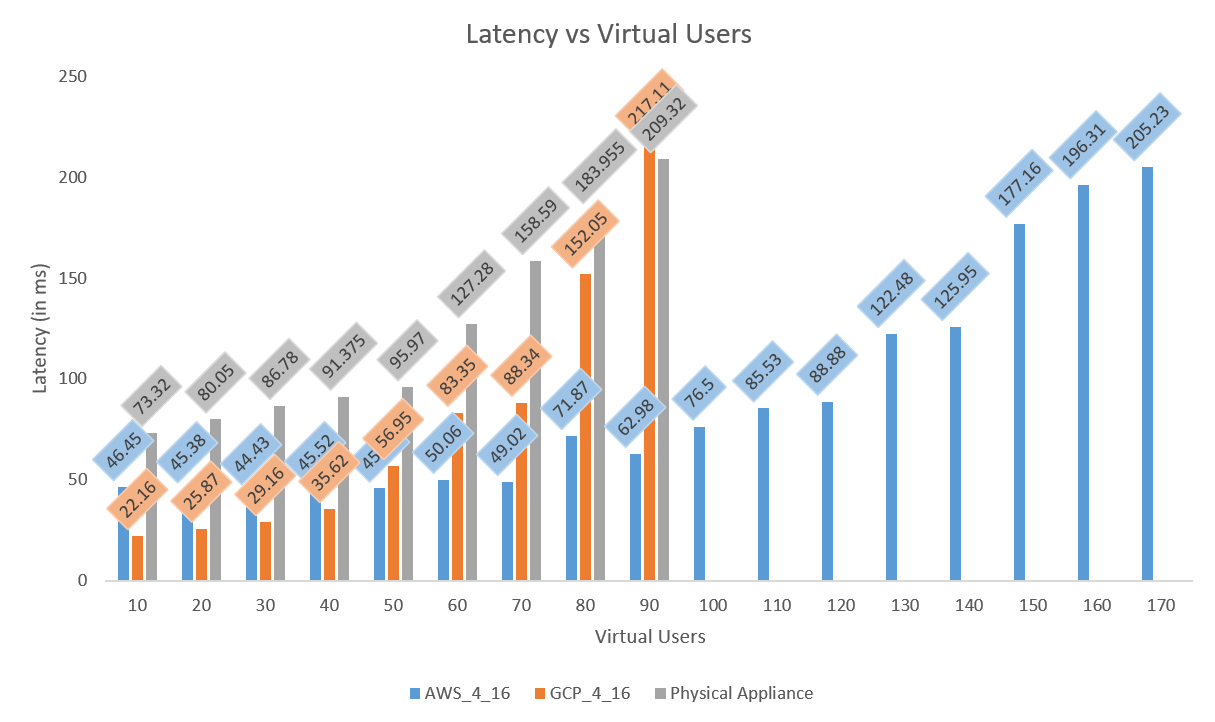
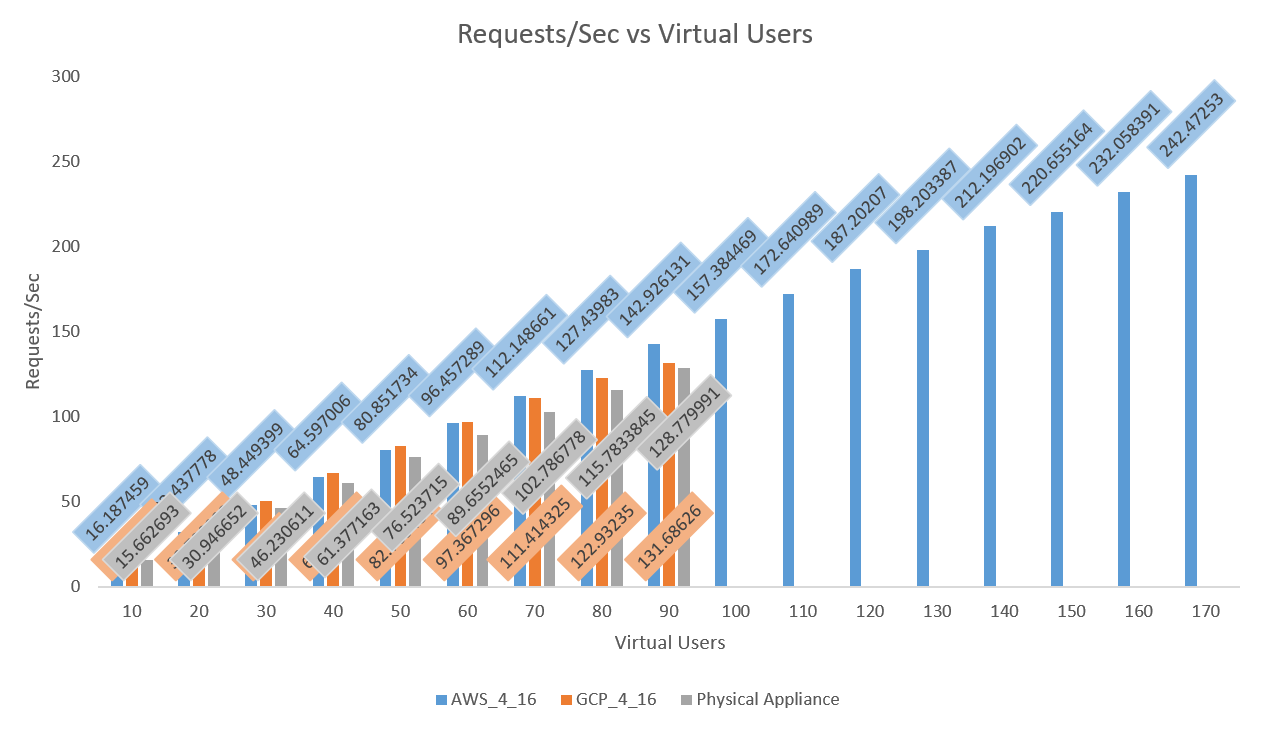
Simulated the wrap requests for Google Calendar on the CipherTrust Manager deployed on a physical appliance using the k6 tool. The following table shows the handled number of requests per second (RPS), with approximate latency, and the number of virtual users for different data sample for three runs.
| Users | Latency (in ms) | Requests/Second |
|---|---|---|
| 10 | 73.32 | 15.662693 |
| 20 | 80.05 | 30.946652 |
| 30 | 86.78 | 46.230611 |
| 40 | 91.375 | 61.377163 |
| 50 | 95.97 | 76.523715 |
| 60 | 127.28 | 89.6552465 |
| 70 | 158.59 | 102.786778 |
| 80 | 183.955 | 115.7833845 |
| 90 | 209.32 | 128.779991 |
Comparison Graphs
Physical Appliance vs AWS Cloud vs Google Cloud
Recommendations
Assumption
Each user has 3 documents open and is editing them resulting in an autosave every 30 seconds, that is, 3/30=0.1 transactions per second (tps) per user.
Number of users = (throughput for around 200 ms latency)/0.1
Google Cloud
-
Response time compliance of around 200 ms was met for a maximum throughput of 131.69 operations per second with a standalone CipherTrust Manager k170v instance with 4 CPUs and 16 GB RAM.
The approximate number of users this configuration can handle is 1317.
-
Response time compliance of around 200 ms was met for a maximum throughput of 252.45 operations per second with a two-node CipherTrust Manager k170v cluster (each node with 4 CPUs and 16 GB RAM) connected with a Google Cloud load balancer.
The approximate number of users this configuration can handle is 2525.
-
Response time compliance of around 200 ms was met for a maximum throughput of 415.02 operations per second with a standalone CipherTrust Manager k470v instance with 8 CPUs and 64 GB RAM.
The approximate number of users this configuration can handle is 4150.
-
Response time compliance of around 200 ms was met for a maximum throughput of 749.70 operations per second with a two-node CipherTrust Manager k470v cluster (each node with 8 CPUs and 64 GB RAM) connected with a Google Cloud load balancer.
The approximate number of users this configuration can handle is 7497.
AWS Cloud
-
Response time compliance of around 200 ms was met for a maximum throughput of 242.47 operations per second with a standalone CipherTrust Manager k170v instance with 4 CPUs and 16 GB RAM.
The approximate number of users this configuration can handle is 2425.
-
Response time compliance of around 200 ms was met for a maximum throughput of 455.05 operations per second with a two-node CipherTrust Manager k170v cluster (each node with 4 CPUs and 16 GB RAM) connected with an AWS load balancer.
The approximate number of users this configuration can handle is 4551.
-
Response time compliance of around 200 ms was met for a maximum throughput of 524.96 operations per second with a standalone CipherTrust Manager k470v instance with 8 CPUs and 64 GB RAM.
The approximate number of users this configuration can handle is 5250.
-
Response time compliance of around 200 ms was met for a maximum throughput of 968.94 operations per second with a two-node CipherTrust Manager k470v cluster (each node with 8 CPUs and 64 GB RAM) connected with an AWS load balancer.
The approximate number of users this configuration can handle is 9689.
Conclusion
The number of users and throughput almost doubles up on moving from CipherTrust Manager k170v to k470v. Moreover, adding an additional node to the cluster also doubles up the throughput. Overall, a performance gain of 400 percent is achieved by moving from a standalone CipherTrust Manager k170v to a two-node CipherTrust Manager k470v cluster.